

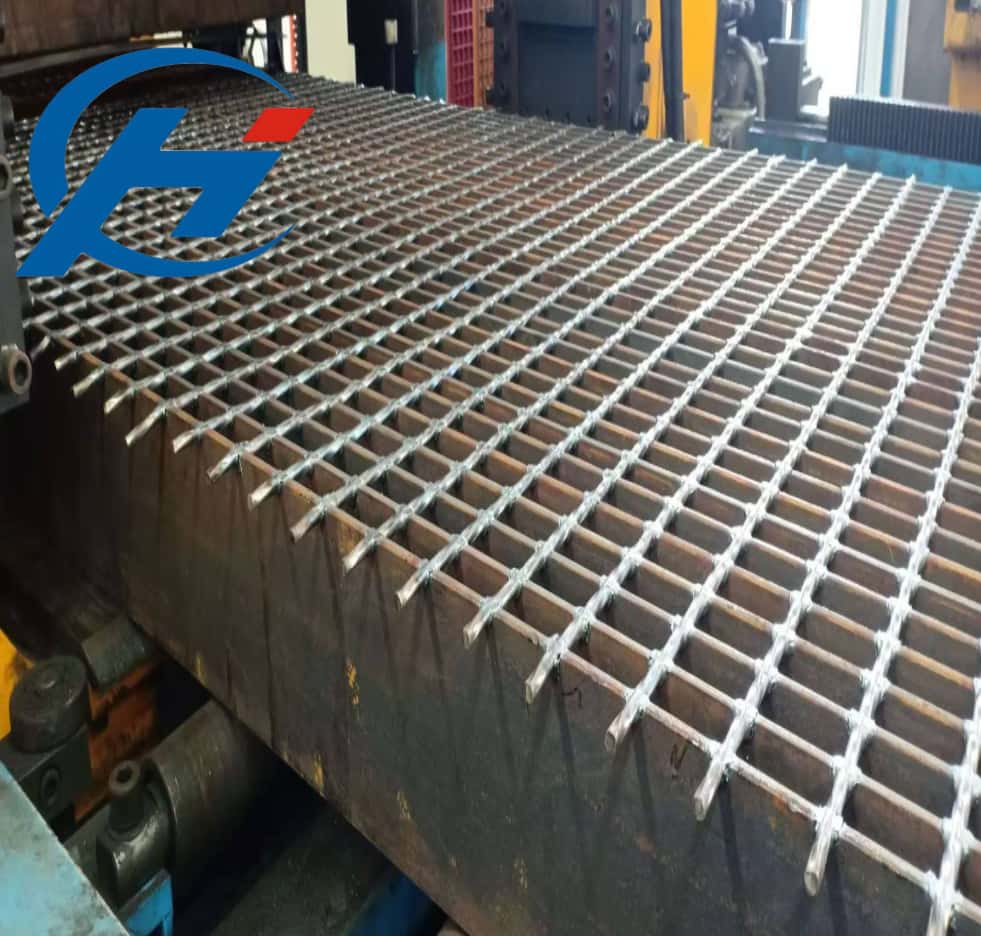
A steel grating weight chart gives a useful starting point only when its specification and weight basis match your panels. Before multiplying the table value by area, check the bar arrangement, material and what the quoted unit weight includes.
Read the unit before doing the calculation
Keep dimensions and weight units consistent. If the chart uses kilograms per square metre, convert millimetres to metres before calculating area. A value stated per panel or per linear metre cannot be used as though it were a square-metre rate.
Illustrative calculation for one rectangular panel
Assume a supplier states a base unit weight of 32 kg/m² for the selected construction, excluding the separately listed edge components. This is an example, not a published weight for a particular grating specification.
- Finished rectangle: 1.2 m × 0.8 m = 0.96 m².
- Base grating estimate: 0.96 m² × 32 kg/m² = 30.72 kg.
- Separately estimated edge components: 2.40 kg.
- Estimated completed panel: 33.12 kg.
For 20 identical panels, the estimate is 662.4 kg before packing. If the confirmed packing allowance is 18 kg, estimated gross shipping weight is 680.4 kg. Keep sufficient precision during calculation and apply the agreed rounding convention at the reporting stage.
Adjust for the actual scope
Do not add banding or coating again if the supplier’s unit weight already includes it. For openings or irregular panels, agree how area and removed material are counted; a bounding rectangle may overstate the remaining grating while missing reinforcement around a cut-out.
Use the right result for the next decision
An estimated panel mass helps planning, but it is not a load rating or a confirmed lifting weight. For shipping or handling, ask for the required verified weights and identification. See the weight-estimate review record and steel grating weight chart overview.
