

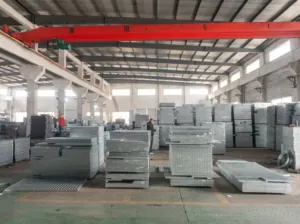
A trench cover must fit the channel and support the intended traffic while allowing the required access and drainage. Start by describing these functions separately; a cover that looks open enough in a photograph may still be unsuitable for the site arrangement.
Define the traffic crossing the trench
Identify pedestrians, carts or vehicles and provide the project’s applicable load requirements. Show the direction of travel relative to the channel and any concentrated load conditions. Ask the responsible designer to approve the cover and support arrangement; a general steel grating description is not a traffic rating.
Describe drainage and debris conditions
Provide the drainage design inputs and explain the expected debris or sediment. Ask the drainage reviewer to assess the opening arrangement and maintenance needs. The open appearance of a grating panel does not, by itself, confirm that the complete channel and outlet can pass the required flow.
Show the frame and bearing detail
Record the trench opening, frame geometry, support condition and finished surface levels. Separate the clear opening from the cover dimensions. Identify irregular channel widths, corners and transitions so those panels are not quoted as repeated standard rectangles.
Plan cleaning and removal
- Identify which covers need to be lifted for cleaning or inspection.
- Specify the access and handling arrangement required by the site.
- Record fixing or restraint requirements and who approves them.
- Provide panel marks so covers can be returned to the correct position.
Before procurement, reconcile the drainage, structural and maintenance requirements on the same drawing revision. Use the site handover checklist to inspect the delivered installation, or visit trench cover grating options to prepare the enquiry.
