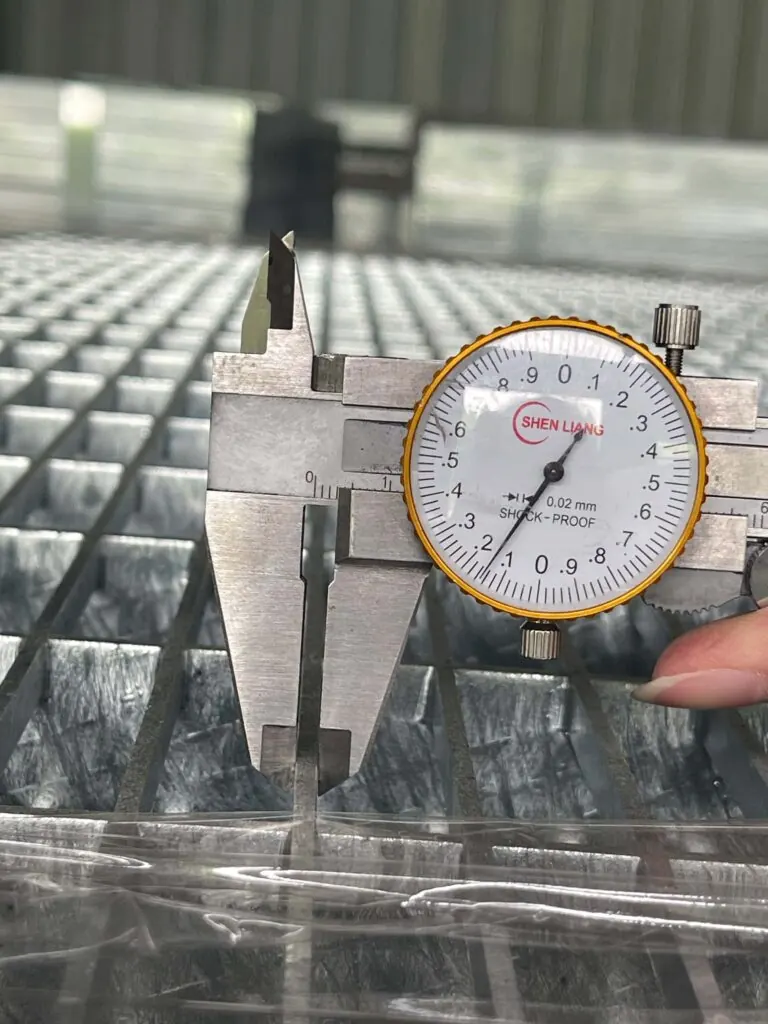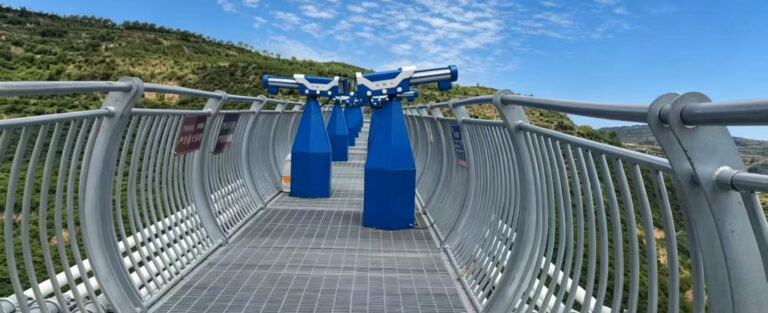

If you searched for “steel grating mackinac,” you are looking at the open steel grid in Michigan’s Mackinac Bridge roadway. It is not a product grade. The grid lets wind pass through the deck, raising the wind speed at which the structure can start to move. Retired sections are sold at auction. This page explains the design reason, the measured panel sizes, and what the principle means when you specify grating.
What the Mackinac Bridge grating actually is
The Mackinac Bridge carries Interstate 75 across the Straits of Mackinac between Michigan’s Upper and Lower Peninsulas. The Mackinac Bridge Authority lists a total length of 26,372 feet, a main span of 3,800 feet, and a roadway width of 54 feet. The road deck sits about 200 feet above the water at mid-span, and the stiffening truss in the suspended span is 68 feet wide, wider than the road it carries.
The grating is part of that road deck, not a walkway add-on. It is an open steel grid: parallel bearing bars with cross bars, with gaps left between them so air and water pass through. A bridge-history reference notes that the open metal grating sits in the inside two lanes. That placement matters, because it tells you the grid was selected for a specific traffic zone rather than applied to every surface on the bridge.
The structure is designed to move. The Authority states that all suspension bridges move to accommodate wind, temperature change, and weight, and that the deck at center span can move as much as 35 feet east or west under severe wind. It describes a slow movement in one direction, not a sway, with traffic weight helping to bring the deck back toward center once the wind drops.
Plain answer: “Mackinac grating” is a nickname for retired or observed sections of this open-grid road deck. You will see it used in auction listings, news reports, and small souvenirs cut from old panels. It is not the name of a bar spacing, a coating, or a load class.
Why an open grid instead of a solid plate
The short version is aerodynamic stability. Engineering histories link the design directly to the failure of the first Tacoma Narrows Bridge in 1940, which became unstable in high wind. David B. Steinman, the Mackinac Bridge’s design engineer, had published an analysis of suspension-bridge stability about three years after that failure. His recommendation was to use deep stiffening trusses to support the deck and an open-grid roadway. Both features were built into the Mackinac Bridge, and both raise the bridge’s critical wind velocity.
A solid deck acts more like a sail. An open grid lets pressure equalize through the road surface instead of building up on one side. The deep truss adds stiffness to the deck it supports. Neither feature works alone: the truss gives the deck bending resistance, while the grid reduces the wind load the deck has to resist. If you only copy the holes and skip the supporting structure, you have copied the appearance without the engineering.
The Authority also puts numbers on the loads the superstructure carries: one ton per lineal foot per roadway, northbound or southbound, across 19,243 feet of steel superstructure. Grating in this setting is a structural deck component with a defined load path, not a decorative floor.
The useful takeaway for a buyer is simple: open area is a structural decision. On the Mackinac Bridge it was chosen to manage wind. On an industrial platform it may be chosen for drainage, light, or airflow. State which job it is doing before you approve a bar spacing.
What retired panels tell you about service life
Original grating reaches the market when the Bridge Authority replaces it. A Detroit Free Press report from January 2025 described sections of approximately 5½ feet by 38 feet by 5 inches, each weighing about 2 tons. The auction listing called the condition “used with corrosion and section loss appropriate to steel that is 60 years old.” The sections had been coated with lead-based paint, and buyers had to sign a hold-harmless agreement covering the paint and the structural condition. The seller would load a section for transport but would not secure the load. Bids on eight sections ranged from $500 to $1,225 at the time of that report, and all proceeds went to bridge maintenance.
A November 2025 report described another batch of five lots with bids starting at $1,525 or more, with buyers able to ask for a section to be cut in two. Smaller pieces have also been sold directly: 5-inch by 8-inch and 5-inch by 11-inch offcuts at $20 each, limited to three per customer, collected in person at the Authority’s administration office and not shipped. The Authority’s own October 2026 update confirms the $20 price, the three-piece limit, office-only collection, and no shipping.
Two details are worth keeping separate. First, these are retired structural members, so the corrosion and lead paint are part of what is being sold, not defects the seller is hiding. Second, the prices above are auction outcomes and small-piece prices reported on specific dates. They are not a price list for new grating, and they should not be used as a benchmark for a current purchase.
We have no connection to the Mackinac Bridge Authority and do not supply or resell these retired sections. The figures are included because they give a rare, documented example of how long a galvanized or painted steel deck can serve before replacement, and what the replacement material looks like.
Open area is a design input, not a pattern
People often notice the grid before they notice the numbers behind it. For a specification, the number that matters is open area: the percentage of the panel surface that is actually void. Open area affects airflow and drainage, but it also changes the bearing bar spacing and the surface a foot or wheel can contact. You cannot increase it for free.
Our guide to open-area evidence for grating explains why drainage claims should be checked against the geometry, not against a product photo. The same approach applies here. If wind flow, drainage, or light transmission is a project requirement, ask for the open area of the exact panel being offered and the bar spacing used to calculate it.
Next, fix the load case. Foot traffic, trolley wheels, and vehicle crossings produce very different demands on the same panel. Our note on matching the grating load case sets out how to describe the traffic before you request a load table. On a bridge, the engineer already knows the load case because it is written into the design. On a plant platform, that job falls to the project team.
Bearing bar direction and span then decide whether the selected bar size works. The bars must span between supports in the direction the load is carried. A panel that passes a load table at one span can fail at a longer span even if the material and finish are identical.
When an open-grid deck is the wrong choice
Open grating is not a universal answer. If small tools or parts can fall through and create a hazard below, a closer bar spacing or a solid cover plate is the better detail. If a surface must be sealed for washing down or for containment, gaps work against you. If the traffic includes small wheels, narrow heels, or regular trolley movement, the walking surface needs to be checked for that contact case rather than for uniform foot loading.
Do not copy the Mackinac detail into a platform specification because it looks proven. The grating there is part of a suspension bridge designed with a deep stiffening truss, a defined lane layout, and an owner that inspects and replaces panels on a bridge maintenance cycle. A mezzanine or access platform has different supports, different loading, and a different inspection regime.
Finish is another place where copying fails. The retired bridge sections carried lead-based paint from an era when that was normal. New work should specify its coating system through the project documents and require the supplier to state what is actually being supplied. Our guide to inspecting the delivered surface shows how to separate a finish claim from a finish record.
A short brief for your own open-grating inquiry
You do not need a bridge-scale project to write a useful inquiry. You need the same disciplines: define the load, the support, the surface, and the evidence you expect back. This table is the minimum we ask for when a buyer wants an open-grid deck.
| Item | What to state | Why it matters |
|---|---|---|
| Load case | Foot traffic, trolley, wheel load, or vehicle crossing, with the applicable value from your project documents | Sets the required bar section and spacing |
| Span and supports | Clear span, bearing direction, and where the panel is seated | The same panel changes capacity with span |
| Open area | Required percentage or maximum spacing, and the function it serves | Drainage and airflow claims need a geometry check |
| Surface and finish | Plain or serrated, and the coating or material named in the specification | Determines slip behavior and corrosion performance |
Once those four items are written down, you can compare offers. Our bridge deck grating specification and quote checklist walks through the drawing and quantity details that usually go missing, and the bridge deck grating guide for infrastructure projects covers the choices that follow from the load case. For infrastructure work, the load, finish, and installation checklist is the natural next step.
Questions buyers ask
Is “Mackinac grating” a product grade I can order?
No. The phrase refers to the open steel grid in the Mackinac Bridge road deck, or to sections removed from it. Search results often mix three things: news about auctions, souvenirs cut from old panels, and general discussion about why a bridge deck is grated. None of those is a specification. If you need grating, describe the load, span, surface, and finish your project requires.
Can a private buyer actually get a piece of the bridge?
At times, yes. The Bridge Authority has auctioned full retired sections through GovDeals and has sold small offcuts at its administration office. The official October 2026 update listed $20 per small piece, a limit of three per customer, office collection only, and no shipping. Availability changes with each replacement cycle, so check the Authority’s own site rather than a reseller.
Why not just pave the deck with solid steel?
Because wind stability. The design followed the lesson of the 1940 Tacoma Narrows failure, using deep stiffening trusses and an open-grid roadway to raise the critical wind velocity. The grid lets air pass through the deck instead of loading it like a plate. The Authority also reports that this deck can move up to 35 feet under severe wind by design.
Can I use the same grating detail on a walkway?
Only after your engineer checks it. The bridge grid is one part of a suspension bridge system. For a walkway, the deciding factors are usually span, load case, bar spacing, slip resistance, and what might fall through the openings. Start with those requirements and compare panels on that basis, not on how closely they resemble a famous bridge.
Sources checked
Bridge dimensions, deck movement, and load figures: Mackinac Bridge Authority, About the Bridge. Design lineage and opening date: Mackinac Bridge, Wikipedia. Retired section sizes, condition, and January 2025 bids: Detroit Free Press, 10 January 2025. Small-piece terms: Mackinac Bridge Authority small grating update, October 2026. Inside-lane placement: HistoricBridges.org bridge profile.
Opening a grating specification does not have to start with a guess. Put your load case, span, and surface requirement on one page, then ask for the panel geometry behind any open-area claim. Our bridge deck grating guides are built around that sequence.