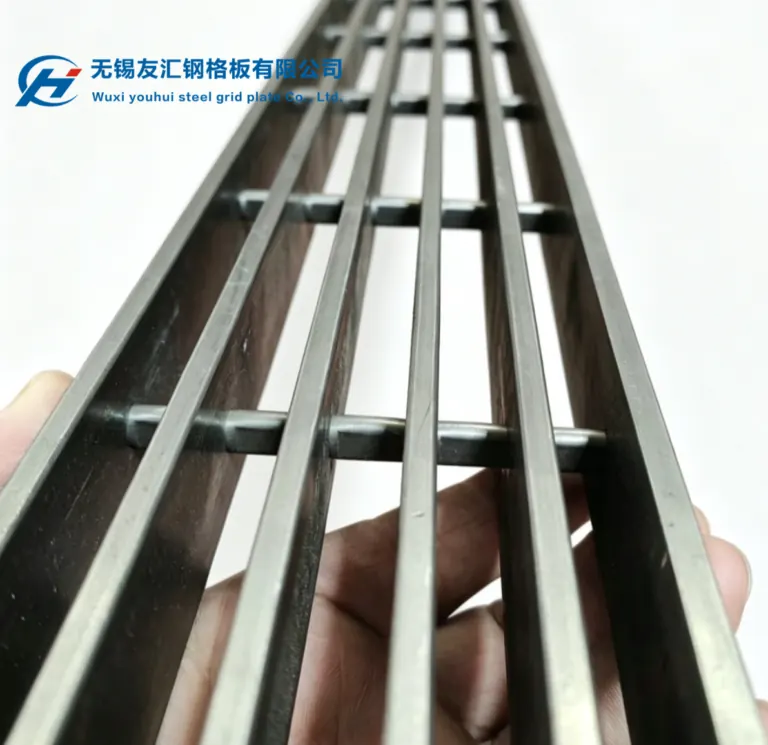

Your spare grating is useful only if you can install it in the intended opening.
Matching the mesh appearance leaves too much unresolved.
Define the panel geometry, support arrangement and fixing details before you order replacements for stock.
Give each spare a defined installation purpose
Start with the locations you need to keep serviceable.
Identify the installed panels by mark and drawing revision, then decide whether each spare will replace one specific panel or an approved family of panels.
Keep that distinction on the purchase schedule.
A spare described only by floor area gives your supplier little information about the actual opening, attachments or orientation it must match.
For repeated bays, confirm that the details really repeat.
You may find the same nominal panel dimensions alongside different cut-outs, edge treatments or fixing arrangements that require separate spare types.
Record which installed panels have changed since the original delivery.
Your maintenance drawing needs to describe the current approved condition before you use it to purchase another panel.
If you cannot trace the original specification, plan a survey and technical review.
Photographs can show the arrangement, but you still need measured dimensions and confirmed material information for an order.
Build an interchangeability schedule
Give each spare family a clear identifier. Under that identifier, record the applicable panel marks and the drawings that establish the permitted installation locations.
Include overall length and width, bearing-bar direction, bar depth and thickness, bearing-bar spacing and cross-bar pitch.
Keep the units visible so your supplier does not interpret a dimension through an assumed convention.
Record the material grade and the required surface and finish.
Your schedule should distinguish a plain panel from a serrated one even when the external dimensions appear identical.
Add the edge details, openings and projecting attachments.
A replacement with the correct outline can still differ from the installed arrangement if a toe plate or local cut-out is missing.
Treat the completed schedule as controlled purchasing information.
When an approved detail changes, revise the spare family record and assess whether previously purchased stock still suits the listed locations.
Confirm the load and support conditions for every location
Ask the responsible designer to confirm the load requirement and support geometry for each intended use.
A panel that fits the opening has not, by that fact alone, been shown suitable for the service load.
Keep clear span separate from overall panel length.
Your spare needs the structural selection checked against the actual supports, with the bearing bars oriented as shown on the accepted drawing.
If a proposed spare serves more than one bay, include every relevant support condition in the review.
Do not infer approval for a longer span from acceptance in a shorter opening.
Identify concentrated or moving loads where those are part of the intended service.
Your technical review needs the real operating condition instead of a general label such as industrial flooring.
Keep the approved load evidence with the spare family record.
Your maintenance team should be able to identify the permitted use without selecting a load-table entry during a shutdown.
Compare the fixing interfaces in detail
Record the fixing arrangement and its relationship to the supporting steelwork.
You need to know whether the proposed spare accepts the specified hardware in the available locations.
For bolted attachments, show the hole locations from defined datums.
Include the required hole dimensions and tolerances from the approved detail, without substituting a workshop’s convenient drilling pattern.
For clip-fixed panels, check access for fitting and tightening the selected assembly.
A visible mesh opening does not establish that the full fixing can be installed around the support beneath it.
Keep removable and permanently attached panels in separate categories where the installation method differs.
Your spare plan should describe how the replacement will be installed and later inspected.
If the original hardware is damaged or unavailable, request an approved replacement detail.
Substituting whatever fastener happens to be in stores can leave your panel outside its reviewed installation arrangement.
Keep handed and asymmetric panels identifiable
Use an orientation arrow on drawings with off-centre openings or unequal edge details.
Your installer needs to distinguish the intended position without trial fitting a heavy panel around equipment.
Mark the reference edge consistently on the schedule and inspection sheet.
This lets you compare measurements from different suppliers without accidentally mirroring the same set of coordinates.
Where left-hand and right-hand versions exist, assign different identifiers.
A shared description that depends on someone remembering the orientation makes future replenishment difficult to check.
Include photographs of the actual interface when they clarify an unusual detail.
Label them with the panel mark and reference direction so they supplement the drawing instead of contradicting it.
Before combining asymmetric panels into one spare family, ask for a documented compatibility check.
Keep them separate when the proposed common detail has not been accepted for every intended position.
Specify the fabrication details you need to reproduce
Confirm the ordered construction, including welded or mechanically locked arrangements where relevant.
Your replacement specification should state the accepted construction instead of leaving the supplier to infer it from a mesh photograph.
Show required banding and attachments on the fabrication drawing.
Ask the supplier to identify any proposed departure before manufacturing, particularly where an edge detail affects fitting or support.
Review how openings will be formed and finished.
If a cut interrupts bearing bars, refer the detail for structural review rather than assuming a matching outer shape establishes equivalence.
Ask for the completed panel dimensions to be checked after the relevant fabrication operations.
Keep the measurement method and acceptance criteria consistent with those used for the original approved spare family.
For finished panels, include the coating or surface-treatment requirement in the order.
A matching colour does not establish that the replacement has the specified finish or the required preparation records.
Decide whether a common spare is worthwhile
List the different details that prevent interchangeability before asking for one common panel.
You can then evaluate whether standardising those details is practical within the project requirements.
Compare the proposed common panel against the full set of installation conditions.
Your approval needs to cover fit and technical suitability, including any effect on removal access or fixing compatibility.
Ask for the mass of the complete proposed panel when handling is a concern.
Include banding and attachments in the scope of that figure so your maintenance plan uses the item you will actually move.
Before reducing your stocked panel types, obtain approval for the common spare at each intended location.
If standardisation would require changes to installed supports, assess that work explicitly. Include that alteration work in your purchasing decision.
Use a controlled first fit
For a new spare family, consider a trial fit at a representative approved location.
Define the inspection conditions and arrange the work through your site’s normal access and maintenance procedure.
Check panel seating, perimeter gaps, adjacent levels and fixing installation against the agreed detail. Record the observations by panel mark so your acceptance has a traceable basis.
Do not extend a successful trial beyond the conditions it represents.
If another bay has a different support arrangement or obstruction, confirm that interface separately before listing it as compatible.
Resolve any required change on the controlled drawing. Your supplier should manufacture later spares to the accepted revision, including changes that were discovered during the trial.
Keep the trial record with the purchase documents.
You can then distinguish an approved spare from a visually similar panel that has never been checked for the intended location.
Store information with the physical stock
Attach a durable identification method suitable for your storage and finish requirements.
The marking should lead back to the spare family and revision without relying on an old packaging label alone.
Keep inspection records and material documents accessible to the maintenance team. Your stock register should identify the panel’s approved use, acceptance status and any outstanding issue.
Inspect stored panels before releasing them for installation. If you find damage, corrosion or a distorted attachment, obtain a disposition before treating the item as a ready replacement.
Record withdrawals and replenishment against the same spare identifier.
Otherwise a later purchase can quietly revert to an older drawing even though the original spare was made to the correct revision.
When you alter an installed bay, check the stock register as part of the change.
You may need to relabel the permitted locations or revise the replacement order after the new detail is approved.
Questions about your spare-panel order
Can you use one spare wherever the panel dimensions match?
You need more than matching length and width. Check the bearing bars, material, support conditions, required load performance and fixing arrangement for each intended location.
Include openings and attachments in that comparison.
Ask the responsible designer to approve the shared spare specification, then list the accepted installation locations on its record so your maintenance team can select it confidently.
Can you buy replacement panels from a different supplier?
You can request a replacement against a complete, verified specification and an agreed acceptance process.
Give the new supplier the controlled drawings and the requirements that establish compatibility.
Ask for proposed differences to be declared before fabrication.
Review those differences and, where the interfaces justify it, arrange a first fit before accepting a larger batch into your maintenance stock.
What should you do when the original panel drawing is missing?
Arrange a measured survey of the opening and installed arrangement, then obtain the technical information needed to establish the replacement specification.
Keep uncertain material or load assumptions identified for review.
Do not turn photographs into guessed dimensions.
Your replacement order should follow a confirmed drawing and approved selection, with any unusual fixing or opening detail shown clearly before fabrication begins.
Prepare your spare-panel enquiry
Use your bar grating options to prepare a spare-family schedule.
Include the installed panel marks, current drawings and intended replacement locations so you can confirm compatibility before placing the order.